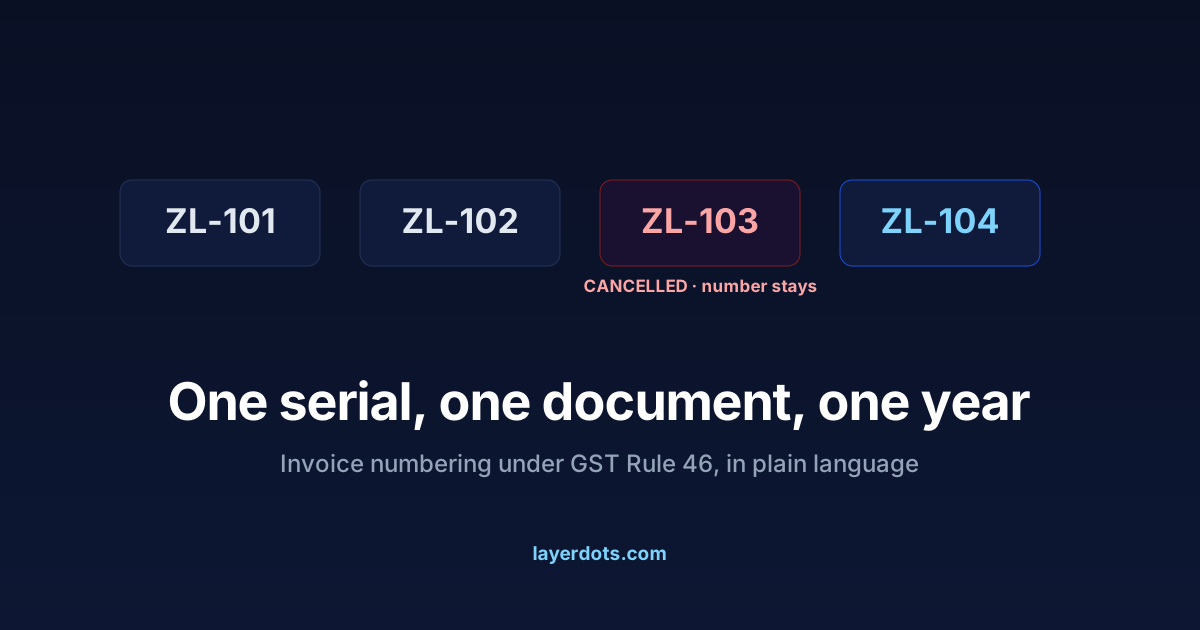
A cashier voids a bill. Ten minutes later somebody asks the question every shop asks eventually: can we use that invoice number again? The answer decides whether your books and your GST return tell the same story, so it is worth settling once, in writing, for everyone who bills.
What Rule 46 asks of a serial number
Rule 46 of the CGST Rules lists what a tax invoice must carry. For the serial number the requirements come to four things.
- A consecutive serial number, not more than sixteen characters.
- It may contain letters, numbers, and the symbols "-" and "/", so INV/2026-27/001 is a legal shape.
- It must be unique for a financial year. One serial, one document, one year.
- You may run one or several series. A counter series and a wholesale series side by side is allowed, as long as each stays consistent.
Notice what the rule does not say. It does not say numbers may never restart; they restart every April, because uniqueness is scoped to the financial year. And it does not use the word "cancelled" at all, which is why the question keeps coming up.
A cancelled invoice was still issued, and Table 13 says so
A cancelled invoice existed. It may have been printed, and the customer may be holding a copy. GSTR-1 has a table for this: Table 13, "Documents issued", where you report the serial ranges used in the period, the total count, and how many of those were cancelled.
That reporting is what closes the door on reuse. If bill 103 is reported as issued and cancelled, and a second bill also carries 103 in the same year, there are two documents on one serial: one your return calls cancelled, one your customer calls their purchase. Any comparison between your books and your return trips over it, and once the return is filed there is no clean way to undo it.
The rule to give the counter is short. A cancelled bill keeps its number for good. The next bill takes the next number. Nobody types an old number back in.
A wrong bill gets a credit note, not a second copy
If goods come back, or a bill was made out for the wrong amount, the fix is not to issue the invoice again under the same number. Section 34 provides the credit note: a separate document with its own number, issued against the original. The original keeps its serial, the credit note reverses the value, and both appear in the return doing their own jobs. We have covered credit and debit notes in their own article, including the deadline on them.
Gaps in the series
Real shops get gaps. A test bill deleted on the first day, a series changed mid-year, an entry removed because it should never have existed. Table 13 is built to describe what happened: you report the documents that exist, as ranges, with the cancelled count alongside.
A gap is not an offence by itself. What matters is that you can explain it. An officer reading your return can see that number 57 is missing and may ask what became of it, and "our software recorded the deletion on this date, here is the log" is a complete answer. Silence is not.
What the software should be doing for you
None of this should depend on a cashier remembering rules in a rush. This is how Layerdots ERP handles it, and it is worth demanding of any billing software.
- Cancel keeps the number. A cancelled bill stays in the books, marked cancelled, holding its serial. The app refuses to give that number to another bill and says why.
- Delete is a separate, deliberate act for bills that should never have existed, such as a test entry or a duplicate. The bill moves to a recycle bin for 30 days, the deletion is written to the activity log with the user's name, and the number becomes available again. Whether to leave a gap or refill it stays your choice.
- Documents issued is prepared for you. The GSTR-1 export reports the ranges that exist, with cancelled documents counted, rather than pretending the series was unbroken.
- Two devices cannot collide. If the phone app also makes bills, both draw from one shared series, so the same number is never issued twice, even in the same second.
The questions that follow a voided bill
Can a cancelled invoice's number be used again?
Not in the same financial year. The cancelled invoice is reported as an issued, cancelled
document in GSTR-1 Table 13, and a second bill on the same serial would contradict that. After
April the new year's series can use the number again.
Can I restart from number 1 every April?
Yes. Rule 46 asks for a serial that is unique within a financial year. Most shops restart at 1
with a year marker in the series, such as 2026-27/001, so old and new bills cannot be
confused.
Is a gap in invoice numbers illegal?
No, but expect to explain it. Keep a record of why the number is missing. Software that logs
deletions gives you that record without extra work.
What if I made a mistake on a bill that is already issued?
Do not edit it, and do not issue it again under the same number. For goods coming back or a
value that was too high, issue a credit note against that invoice under Section 34. The
original keeps its number and the credit note carries its own.
This article is general information for shop owners, not legal advice. For a dispute or a notice, speak to your CA or a GST practitioner.