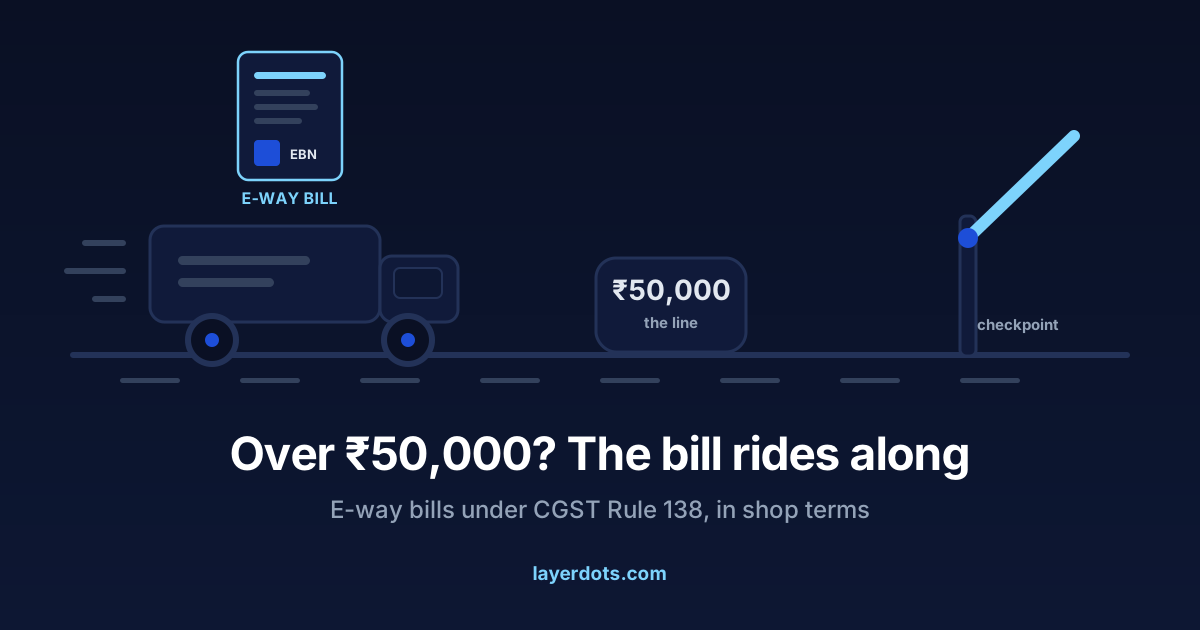
The van is loaded, the invoice is printed, and someone asks the question that stops the loading: does this trip need an e-way bill? The worry is reasonable. A vehicle moving goods without one can be stopped and detained, and the penalty is not small. The answer, though, is in one place, Rule 138 of the CGST Rules, and it is shorter than its reputation. This is Rule 138 in shop terms, so you can decide for this consignment, today.
What the e-way bill is, and what travels with the goods
An e-way bill is an electronic movement slip. Before goods start moving, you or your transporter enter the consignment details on the government portal, ewaybillgst.gov.in, and the portal returns an e-way bill number. That number travels with the goods. Under Rule 138A the person in charge of the vehicle must carry the invoice (or bill of supply, or delivery challan) and the e-way bill number, on paper or on a phone.
It is not a new tax and not a new kind of invoice. It is also not an e-invoice, which is a separate mandate for larger businesses covered in the ₹5 crore e-invoicing threshold. The e-way bill answers one question only: what is moving, from whom to whom, and in which vehicle.
₹50,000 including GST, per consignment
Rule 138(1) says a registered person who causes movement of goods of consignment value above ₹50,000 must generate an e-way bill before the movement begins. The value includes GST: the explanation to Rule 138(1) counts the value declared on the invoice, tax included, so goods worth ₹48,000 at 18% GST make an invoice of ₹56,640, which is over the line even though the goods alone are not. Exempt goods on the same invoice are left out of the count. And the test is per consignment, per movement, not per day and not per customer. Goods worth ₹49,500 including tax are under the line for an ordinary sale.
Two kinds of movement need a bill regardless of value, both across state lines: goods sent for job work, and handicraft goods moved by a person exempted from registration. In the other direction, Rule 138(14) lists movements that never need one, including transport by non-motorised conveyance (a handcart or a cycle rickshaw) and a schedule of exempted goods.
Who generates it
The rule points at whoever causes the movement. If you send goods to a buyer in your own van, or by a tempo you booked, that is you. If a registered buyer arranges the pickup, it is the buyer. If neither of you has generated one by the time the goods reach a transporter, Rule 138(3) lets the transporter generate it from the Part A details you supply.
In practice the shop that raises the invoice usually generates the bill, because everything Part A asks for, both GSTINs, invoice number and date, HSN codes and value, is already on the invoice. If you bill other shops regularly, keeping those details clean at billing time is most of the e-way bill work done in advance. Layerdots ERP keeps them on every bill and generates the e-way bill from the saved invoice on its Gold and Platinum plans; on any plan, a number generated on the portal can be typed onto the bill.
Part A, Part B, and the validity clock
The form has two halves. Part A is what is moving: the invoice details, the parties, the value, the HSN codes. Part B is how it moves: the vehicle number, or the transporter's document number for rail, air or ship. A bill with only Part A is not yet valid for movement. The validity clock starts when Part B is first filled in.
Validity comes from Rule 138(10): one day for a journey of up to 200 km, and one more day for every further 200 km or part of it. For the distances a shop usually ships, one day is plenty. If a breakdown or a diversion eats the time, the same rule allows an extension in exceptional circumstances, and a breakdown is the textbook case. The portal opens the extension option around the expiry time, so whoever generated the bill should extend it before it lapses rather than the next morning. An expired bill at a checkpoint is treated like a missing one.
One relief for short first legs: when goods travel from your shop to a transporter's hub within the same state and that leg is 50 km or less, Part B can wait until the goods leave the hub.
The customer carries it, you deliver it, or it goes to your other branch
The customer carries it home. A walk-in customer pays at the counter and takes the goods in their own car. The movement is now caused by an unregistered person, and for that case Rule 138 makes generation optional, at that person's choice. This is why an ordinary retail counter can go months without touching the portal. Many shops generate anyway on a large counter sale, say ₹70,000 of goods leaving in the customer's own car, and hand the number to the customer; it costs a few minutes and removes the argument at a checkpoint. The moment you deliver instead, the movement is yours, and the ₹50,000 test applies to you.
Your own delivery. A hardware counter sending cement, pipe and fittings to a site in the next district can cross ₹50,000 in one load without anything feeling large. You generate the bill, your vehicle number goes in Part B, and the driver carries the invoice and the bill number.
Stock to your own second shop. No sale happens, but goods still move, and Rule 138 covers movement for reasons other than supply too. Above the line it needs an e-way bill. Within the state under the same GSTIN, the goods travel on a delivery challan under Rule 55; a branch in another state counts as a distinct person under GST, so that transfer gets a tax invoice like any other B2B movement.
Inside the state, the line may sit elsewhere
₹50,000 is the figure for movement between states. For movement inside a state, each state sets its own threshold, and several have raised it to ₹1 lakh or exempted certain local movements entirely. So a consignment that needs no bill inside your city may need one the moment it crosses the border. Check your own state's notification on the e-way bill portal before relying on a higher limit a neighbour told you about.
When in doubt, generate. An e-way bill that turns out not to have been required harms nothing and costs nothing. A missing bill that was required can cost twice the tax on the goods, and ten minutes at the keyboard is the cheap side of that bet.
What detention under Section 129 costs
If a vehicle is stopped and the bill is missing or wrong, Section 129 of the CGST Act allows the goods and the vehicle to be detained. Since 1 January 2022, release where the owner comes forward means a penalty equal to 200% of the tax payable on the goods, and the exposure is higher when no one claims them. The penalty is only half the damage. The van stands at a checkpoint, the driver waits, the customer's site waits, and anything perishable keeps its own clock. Set against that, Part A is a form your billing software has already filled.