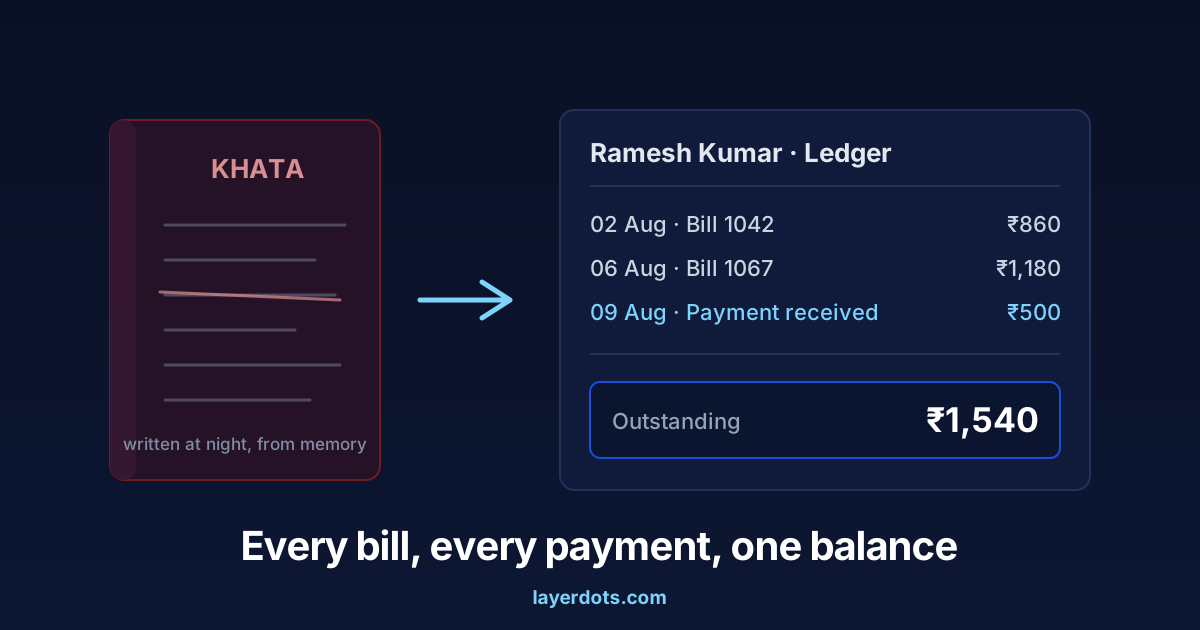
Every shop with regular customers has a khata, because credit keeps good customers coming back. The trouble is credit that nobody can state precisely: who owes what, since when, against which bills. Add it up one slow afternoon and a month's profit may be sitting in other people's pockets. This is about running udhaar deliberately: recording it at the counter, capping it per customer, showing a statement that ends arguments, and asking for the money without a fight.
Credit is a service with a cost
Credit is often the reason a family buys the month's ration from your counter instead of a supermarket, so it is worth offering. But you have already paid your supplier for that stock, which means every rupee on the khata is your own money, lent out at no interest. A service needs rules: who gets credit, how much, for how long, and what happens at the limit. None of this needs software. It needs decisions made once, calmly, and then held at the counter.
Where the evening notebook leaks
The traditional method, billing all day and writing the udhaar into a notebook at night, leaks in four places.
- Memory. The entry is written hours after the sale, from a tired memory. Small amounts get rounded, and some evenings an entry never gets written at all. Whatever is not written down is, to the customer, not owed.
- Disputes. The notebook is your private record. When a customer's memory differs from your handwriting there is nothing neutral to point at, so the argument becomes about trust instead of arithmetic, and you let the amount go to save the relationship.
- Part payments. A customer gives ₹500 against ₹1,700. Does it clear the oldest bill or the newest? Scribbled subtractions in a margin turn one payment into three future disagreements.
- One person. The notebook lives in one head. The day you are away, nobody else can say what a customer owes or safely take a payment against it.
All four have the same cause. The recording happens hours after the sale, by a different person or the same person in a different state of mind.
Write the credit on the bill, at the counter
The fix is to make credit a part of billing rather than a separate chore. The bill already carries the date, the items and the amount. If a credit sale is simply a bill marked as credit, the record is created at the one moment when both of you are looking at the same numbers, and a customer who watched the amount being written at the counter rarely disputes it a month later.
This is the same habit that makes a busy counter fast; what billing at a kirana counter needs covers the rest of it. In Layerdots ERP a credit sale is an ordinary GST bill with the payment marked as credit. It lands in that customer's ledger by itself, with no notebook to catch up on at night, and the customer's page has a button that sends a payment reminder on WhatsApp with the outstanding amount already written in.
If staff bill for you, decide as shop policy who may put a sale on credit at all. An open udhaar habit is an easy way for stock to walk out under a name nobody checks; that question is covered in staff permissions and shop theft.
A limit per customer, decided when things are calm
The worst place to decide how much credit a customer deserves is at the counter, with the customer in front of you and a queue behind them. Under that pressure the answer is nearly always yes.
So decide earlier, in the evening, customer by customer. A salaried regular who clears the khata on the first of every month can carry more. A new face gets little or nothing until a pattern shows. A trader buying in bulk is a different case altogether: a wholesale counter runs on credit by default, with limits set by payment history and margin rather than friendship.
The number does not need to be scientific. It needs to exist before the moment of pressure, so that at the counter you are not judging a person. You are reading a rule: this account is at its limit.
A statement with every bill and every payment
When a customer doubts the total, do not defend the total. Show the parts. A statement that lists every bill with its date and amount, every payment with its date, and one running balance changes the conversation. The customer is no longer asked to accept ₹1,540. They are asked whether the bill of 2 August happened, and whether the ₹500 paid on 9 August was counted. Each line is small, specific, and checkable against the bill copies they were handed at the time.
Most disputes end there, because the disagreement was never about honesty. It was two incomplete records. One complete record, shown calmly, settles it.
Part payments and which bills they clear
Make it a standing rule that payments clear the oldest bills first. Say so, and apply it every time.
Oldest-first matters because debt ages badly. A bill from last week gets paid; a bill from four months ago slowly becomes a story with two versions. If payments keep clearing the newest bills, the old core of the debt quietly becomes permanent while the account looks active. Oldest-first keeps the balance young and shows the truth early: a customer whose oldest unpaid bill keeps getting older is not really paying, whatever this week's ₹500 suggests.
When the ledger applies each payment and shows which bills it cleared, the rule costs no effort. In a notebook, this is exactly the arithmetic that goes wrong.
Pausing an account without losing the customer
Watch for three signals: the balance has sat above the limit for weeks, the payments coming in are smaller than the new purchases going out, or the customer now sends someone else to the counter. Any one of them means the account needs a pause rather than more room.
Then say it without accusation, because the goal is a paying customer, not a won argument. Blame the rule, not the person: the account is at its limit, so let us clear some of the old balance first, and today's purchase is on cash. With the statement open between you, this is shop policy rather than an insult. Most customers accept it. The few who walk away were usually the ones quietly deciding never to pay.
Pausing credit is not losing the customer. Continuing unrecorded credit is losing the money and, when it finally surfaces, the customer too.
Questions that come up
A customer says my balance is wrong. What do I do?
Do not argue about the total. Go through the statement line by line and ask which specific
line they disagree with. Most gaps turn out to be a payment remembered on a different date, or
a bill made by a family member. A line-by-line record turns a trust argument into an
arithmetic check.
Should I charge interest on udhaar?
Most retail shops do not, and for a good reason: interest sours a relationship over small sums
and is hard to demand if it was never clearly agreed. Your real cost is not the missing
interest but the missing principal. Tight limits and oldest-first collection recover more
money than an interest column ever will. Large trade credit under a written agreement is a
conversation for your accountant.
How long can an unpaid khata legally wait?
Generally, under the Limitation Act, 1963, a suit to recover a debt must be filed within three
years; a signed acknowledgment (Section 18) or a qualifying part payment (Section 19) can
restart the period. Court recovery rarely makes sense for counter-sized dues anyway. Keep
every balance young instead: share the statement monthly, clear oldest bills first, and pause
credit early.