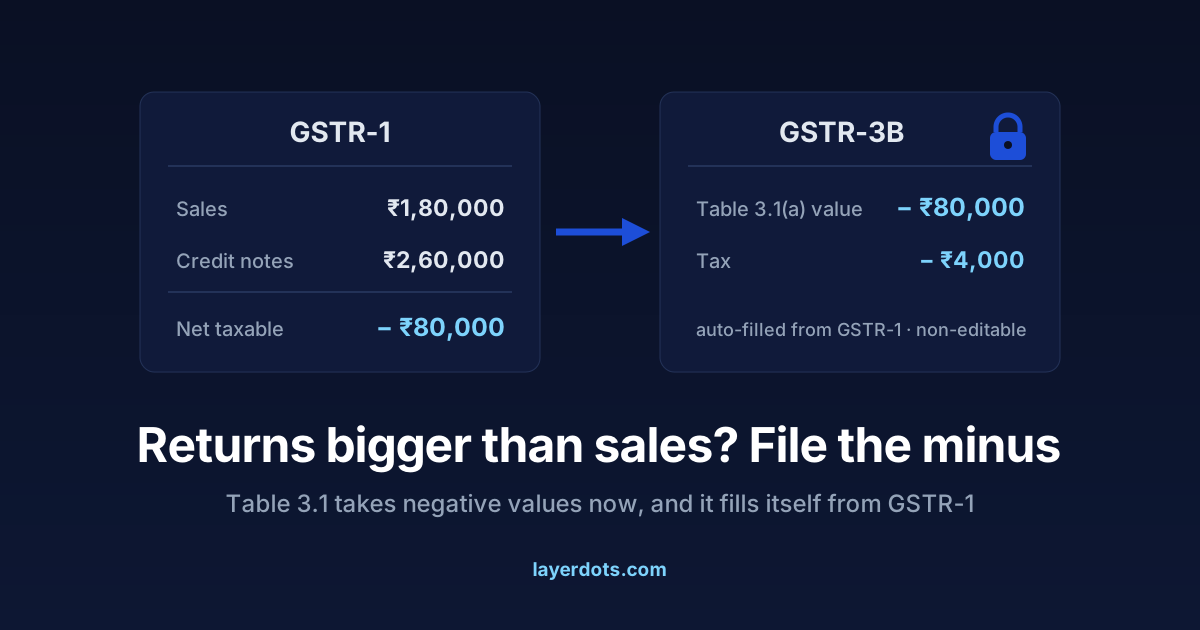
The season ended, the racks came back, and when you total the month your credit notes are bigger than your sales. Net taxable value: minus ₹80,000. Most of what ranks for this question says GSTR-3B cannot take a negative figure, so show zero and adjust the balance against next month's sales. That was correct advice about a portal that no longer exists. Since January 2025 Table 3.1 accepts negative values, and since the July 2025 tax period you cannot type a different figure into it anyway. Here is what you file, as the portal behaved when we checked in August 2026.
File the negative figure
When credit notes for a month exceed the month's sales, the outward figures for that month are negative, and negative is what gets filed. Two portal changes settle it:
- Table 3.1 of GSTR-3B accepts negative values. GSTN switched this on in late January 2025, precisely for the case of a month with sales returns and little or no sales. Taxable value and tax show with a minus sign, and there is nothing to pay under that head.
- You no longer type Table 3.1 at all. From the July 2025 tax period, the outward liability that fills in from your GSTR-1 is locked (GSTN advisory dated 7 June 2025). GSTR-3B shows what your GSTR-1 produced, to the rupee.
So the filing work happens one return earlier. Put every credit note into GSTR-1 in the month you issued it: document by document in Table 9B for registered buyers, netted into the B2C summary in Table 7 for counter sales. If the notes outweigh the sales, GSTR-1's summary for the month comes out negative, GSTR-3B inherits the minus, and you file what flows. If the auto-filled figure is wrong, the correction is GSTR-1A, filed after GSTR-1 and before GSTR-3B for the same period, because there is no edit box left inside 3B.
Corrections now flow downhill, from GSTR-1 into GSTR-3B. Any advice that involves typing a different number into GSTR-3B is describing the portal as it worked before July 2025.
Advice written before 2025 describes a form you can no longer edit
Articles written between 2017 and 2024 tell you the portal will reject a minus in Table 3.1, and back then it did. The accepted workaround was to floor the month at zero and carry the unabsorbed credit notes forward until future sales absorbed them. Those pages still rank because the question has not changed. Only the portal has.
The workaround now fails on both ends. It is unnecessary, because the minus is accepted. And it is impossible to execute where it used to be executed, because the 3B rows it relied on are locked. The only place a carried-forward adjustment can live any more is a later month's GSTR-1, which means netting a stale credit note into a month it does not belong to. That has real costs, covered below.
The lock is spreading. Table 3.2, the split of inter-state supplies to unregistered persons, composition dealers and UIN holders, became auto-populated and non-editable from the November 2025 tax period (GSTN advisory of 5 December 2025, after an earlier attempt in April 2025 was put on hold). GSTR-3B is turning into a computed return rather than a typed one.
The dates that decide which advice is current
With this topic, the year a page was written decides whether it is right. These are the changes that matter, each checkable by name:
| What changed | In force from | Where it says so |
|---|---|---|
| Supplier credit notes net into Table 4(A) of GSTR-3B, and a negative 4(A) or 4(D) is filed as a negative | January 2023 period | GSTN advisory, 17 February 2023 |
| GSTR-1A: amend the same month's GSTR-1 after filing it, before GSTR-3B | July 2024 period | Notification 12/2024-Central Tax, 10 July 2024 |
| Table 3.1 of GSTR-3B accepts negative values | Late January 2025 | GSTN portal update, reported 23 January 2025 |
| Auto-populated outward liability in GSTR-3B locked; corrections only via GSTR-1A or a later GSTR-1 | July 2025 period | GSTN advisory, 7 June 2025 |
| Table 3.2 auto-populated and non-editable | November 2025 period | GSTN advisory, 5 December 2025 |
A quick test for anything else you read on this subject: if the page does not mention the last two rows, its GSTR-3B instructions describe a form you can no longer edit.
A worked month
A garments shop sells hard through the wedding weeks. The month after, stock comes back from customers and from the two boutiques it supplies on credit. New sales in the month are ₹1,80,000. Credit notes issued in the month total ₹2,60,000, all at 5 percent.
| Line | This month |
|---|---|
| Sales billed in the month | ₹1,80,000 |
| Credit notes issued in the month | ₹2,60,000 |
| Net taxable value in GSTR-1 | minus ₹80,000 |
| Tax at 5 percent (CGST + SGST) | minus ₹4,000 |
In GSTR-1, the boutiques' credit notes go into Table 9B against their original invoices, and the counter returns net into Table 7. The month's summary comes out at minus ₹80,000 taxable and minus ₹4,000 tax. GSTR-3B Table 3.1(a) picks up both figures with the sign intact, and the payment table asks for nothing under that head.
Be clear about what the minus does not do. The tax on the returned goods was paid in the months they originally sold, and a negative month does not push cash back to you. Nor does GSTR-3B carry the unabsorbed ₹4,000 into next month on its own: since the lock, next month's 3B is built from next month's GSTR-1 alone. The negative month puts the truth on record in the right period. Whether the excess can come back in cash is a refund question (Section 54 has a head for excess payment of tax), and one to take to your CA before filing the claim, not after.
Table 4 can go negative too
The mirror case is your own returns to suppliers. A pharmacy sends a carton of expired strips back up the chain, and the stockist issues a credit note. Since the January 2023 period, under the GSTN advisory of 17 February 2023, supplier credit notes net into Table 4(A) of your GSTR-3B rather than appearing as a reversal in 4(B). In a heavy expiry month the notes can exceed the month's fresh purchases, and then 4(A) itself is negative. The advisory is explicit: report the negative, do not floor it at zero. Older posts that put supplier credit notes in 4(B) are describing the pre-2023 form.
Two neighbouring points, so they do not get mixed up. Returning stock against a supplier's credit note is different from destroying expired stock you could not return; the destruction case has its own ITC rule, covered in GST on expired stock and ITC reversal. And supplier credit notes now pass through the Invoice Management System before they touch your GSTR-2B; from the October 2025 period you can keep one pending for a time, but reject a genuine note by mistake and the tax your supplier had reduced is added back to his liability. Treat the IMS queue as part of filing, not as an inbox.
The 30 November bar
Section 34(2) of the CGST Act puts a hard stop on credit notes: the note must be declared in a return by 30 November following the end of the financial year of the original supply, or by the date of your annual return if that comes first. A note for a March 2026 sale must be declared by 30 November 2026. Under the old carry-forward habit, an excess that "waits for sales to absorb it" can still be waiting when the bar falls, and then the tax reduction is lost rather than late.
Even inside the window, carrying forward moves money into months it does not belong to. The portal reconciles per period: Rule 88C compares each month's GSTR-1 against the same month's GSTR-3B, and a gap between the two returns now produces an automatic intimation. Show zero in the return month and net the excess later, and you have overstated one month's turnover and understated another's. If the two months sit in different financial years, both years' turnover figures are wrong, which surfaces in GSTR-9 and in every threshold that reads turnover, from HSN digits to e-invoicing. A minus filed in its own month keeps every period truthful and needs no memory.
It has to be a credit note on the day the goods come back
None of the above can be fixed on the 11th if the returns were never recorded as credit notes. In a busy week, returned goods get handled as a deleted bill or a scribbled exchange, and at filing time the credit notes do not exist. The rule that keeps a return-heavy month filable is dull: every sales return becomes a credit note under Section 34, tied to the original invoice, dated the day the goods came back.
In Layerdots ERP a return recorded against the bill becomes exactly that credit note, and the GSTR-1 files it exports carry the note in the month it happened, in Table 9B or netted into the B2C summary, so the negative that reaches Table 3.1 is the true one. The principle holds with any software, or with a bill book: if the return did not produce a credit note, your GSTR-1 does not know about it, and now GSTR-3B only knows what GSTR-1 tells it.
Common questions
The portal auto-filled a negative figure in Table 3.1. Can I edit it to zero before
filing?
No. From the July 2025 tax period the auto-populated liability is locked. If the figure is
right, file it; a negative month is a legitimate return. If it is wrong, the wrong data is in
your GSTR-1, and the fix is GSTR-1A before you file GSTR-3B, or the amendment tables of a
later GSTR-1.
Does a negative month get me the tax back?
Not by itself. The tax on the returned goods was paid in the months of the original sales, and
GSTR-3B collects tax; it does not hand it back. A negative month records that you owe nothing
under that head, and next month starts fresh from next month's GSTR-1. Recovering the excess
in cash is a separate refund claim under Section 54, and worth a CA's eyes before you make
it.
I showed zero last month the old way and I am still carrying an excess. How do I
unwind it?
The parked credit notes are still undeclared, so declare them: put them in your next GSTR-1
in their own tables, and the reduction flows into that month's GSTR-3B, negative if it has to
be. Check the Section 34(2) date first, and keep the working papers showing which notes moved
and when.
Where exactly do B2C returns go in GSTR-1?
Ordinary counter sales are reported in Table 7 net of credit and debit notes, so a B2C return
reduces Table 7 in the month of the note, not the month of the original sale. Notes against
registered buyers go document by document into Table 9B, as do notes against the large
inter-state B2C invoices reported in Table 5.
Is there a deadline for the credit note itself?
Section 34(2) fixes the date for declaring the note in a return: 30 November after the end of
the financial year of the supply, or the annual return date, whichever is earlier. A note
issued and declared in its own month never meets the deadline at all.