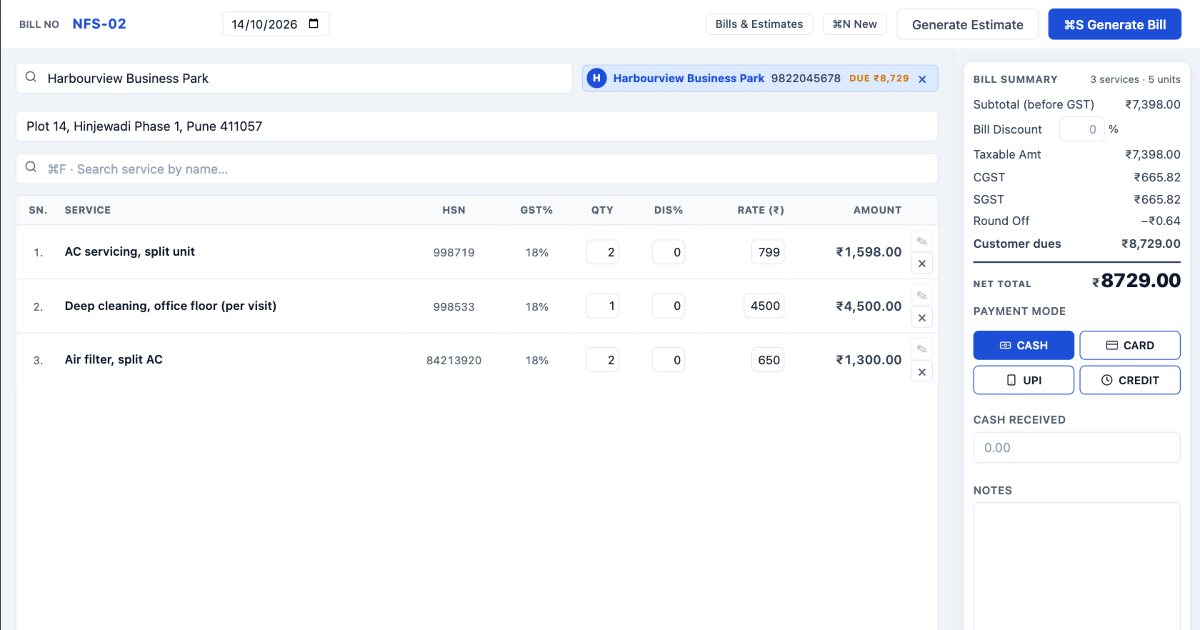
A repair shop, a cleaning or maintenance company, a consultant, a salon: the work is the product. There is no shelf to count, the code on the bill is a SAC rather than an HSN, and the client who calls every week would usually rather settle one bill than five. Billing software built round a stock list makes such a business type a quantity of one against everything it sells and then ignore the stock column for ever.
Layerdots ERP has a trade for it, Service business. Pick it when you set up the business, or change the business type later in Settings, and the app speaks in services: the Inventory page becomes Services, a new item is a service that never runs out, and the invoice heads its code column HSN/SAC.
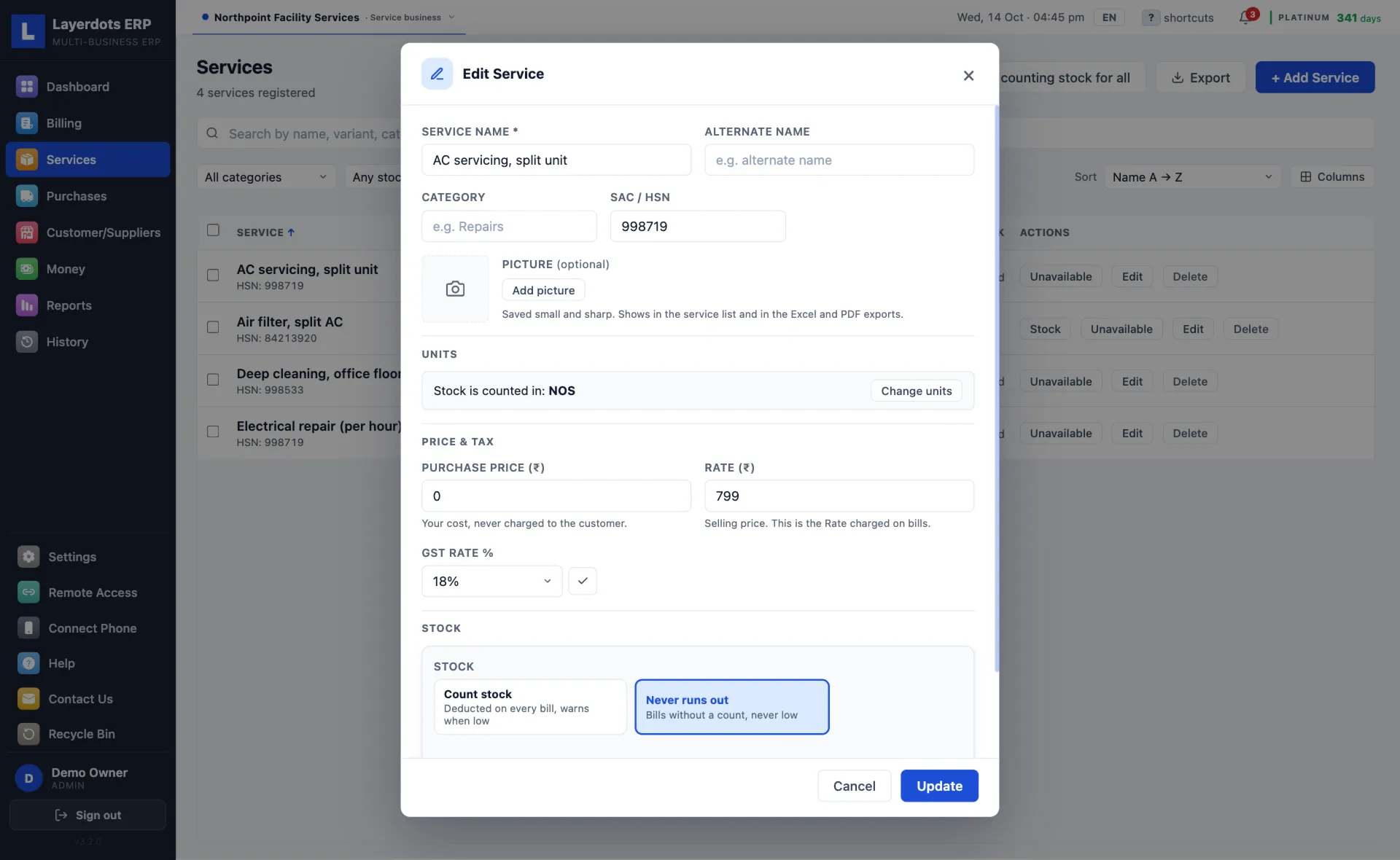
Services with their SAC codes
Each service has its name, its rate and its GST rate, and a SAC / HSN box for its code: 998719 for maintenance and repair, 998533 for cleaning, whatever your CA has given you. GST runs on the usual rates for services, and the invoice carries the code against every line, so a business client's accountant can match it.
A part sold now and then
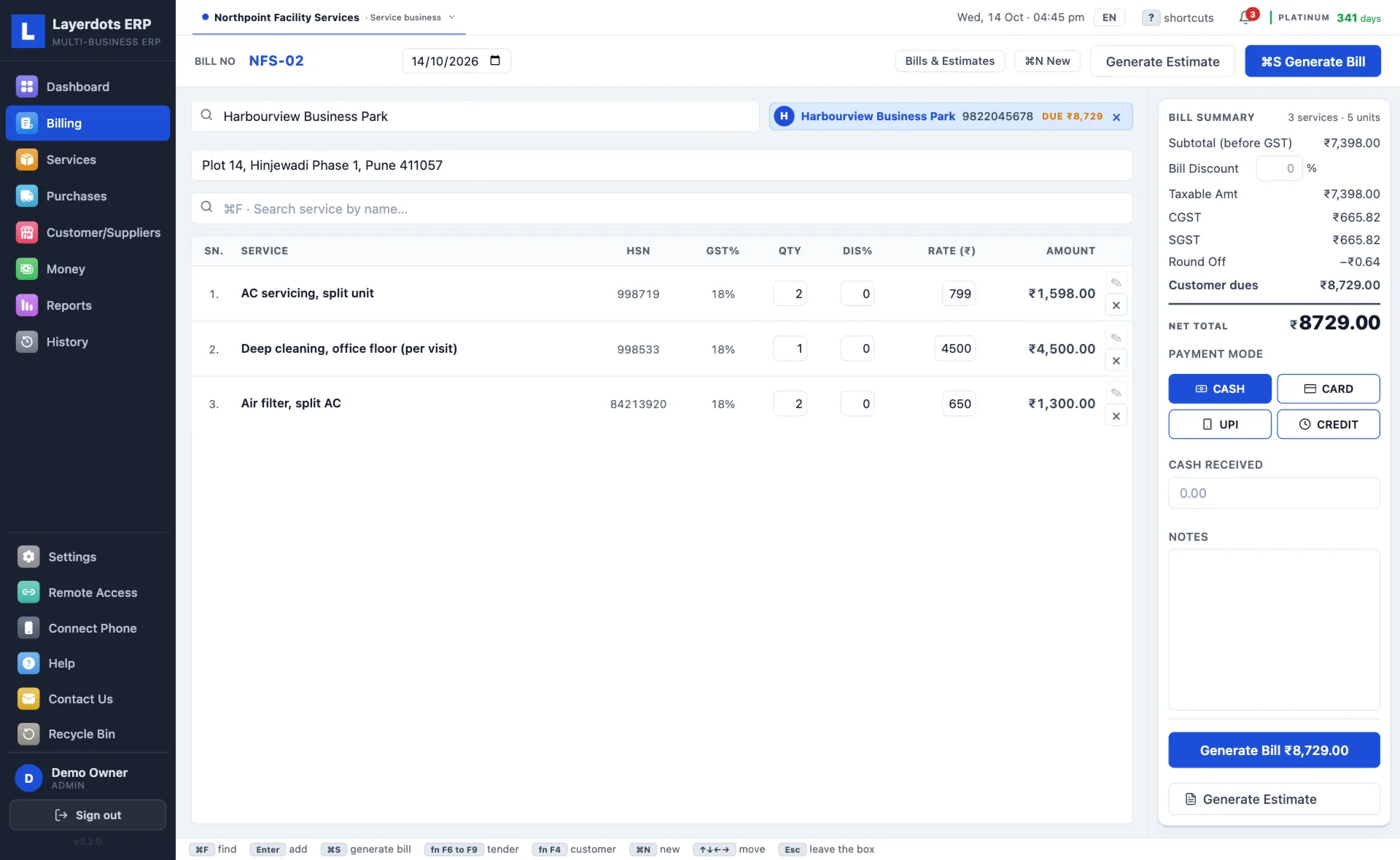
Most service businesses sell a few goods beside the work: a filter with the AC service, a spare part with the repair. Those can be counted. Choose Count stock on the item, with its HSN code, and every bill takes from its count and warns when it runs low, while the services beside it stay uncounted. Both go on the same bill.
The invoice
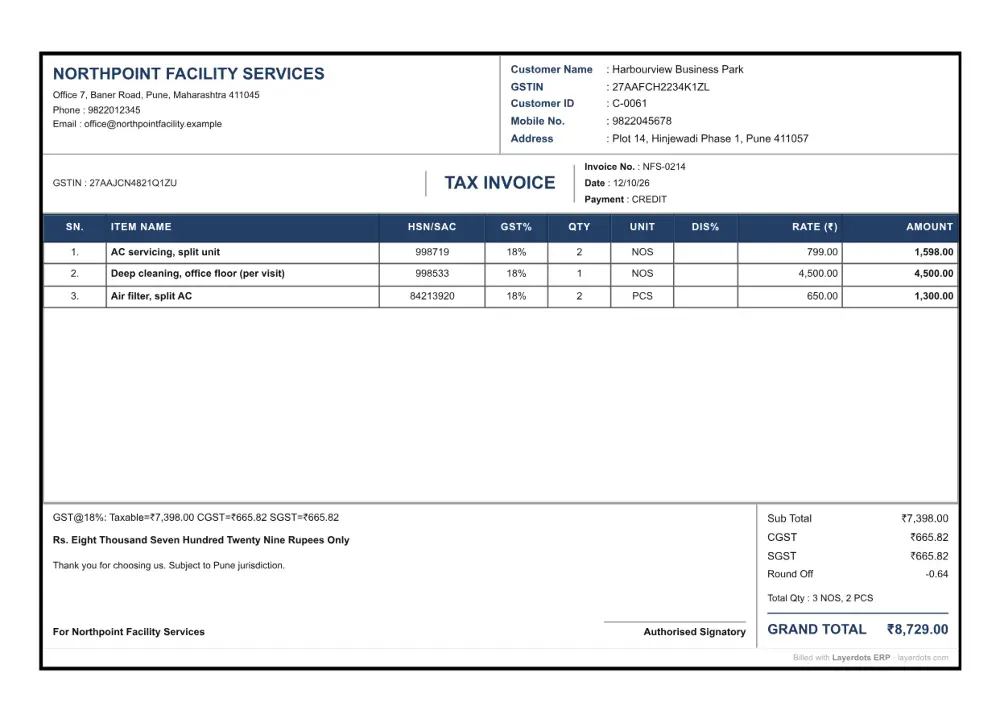
A service business starts on the A5 half sheet, and A4 or a thermal roll is one setting away. The bill is a tax invoice with the client's GSTIN, the codes in the HSN/SAC column and the GST summary, in whichever of the app's six designs and in the colour the business picks. The terms at the foot start with a line written for a service business, and you can rewrite them.
One invoice for a client's month
A taxi company in Layerdots puts a client's trips for the week or the month on one consolidated tax invoice, one block per trip and the GST worked out once on the total. The same consolidated invoice, and the estimate that goes with it, is being added for service businesses as a setting you switch on, for the client who wants one bill for every visit in a month. Until it arrives, each visit is billed on its own, and the Account Statement gives that client every bill of the month on one sheet with the balance due.
Things a service business asks
Can a service business take the composition scheme?
Not in this app. Composition under section 10(1) is for goods and restaurants, and the separate 6% scheme for
services is not one the app offers, so a service business bills under the regular scheme. The app says so in words
if you try to choose composition.
We run a taxi company. Is this the trade?
There is one made for you: Taxi and travel, with duty slips, packages by
hours and kilometres and the consolidated invoice. Service business is the plain version, with no cabs on the bill.
What does it cost?
Seven days free with every feature, no online account and no card. After that, Basic is ₹3,800 + GST = ₹4,484 a year,
Gold ₹7,000 + GST = ₹8,260, Platinum ₹11,000 + GST = ₹12,980; the pricing section has what
each plan includes. The same app runs on Windows and on a Mac.