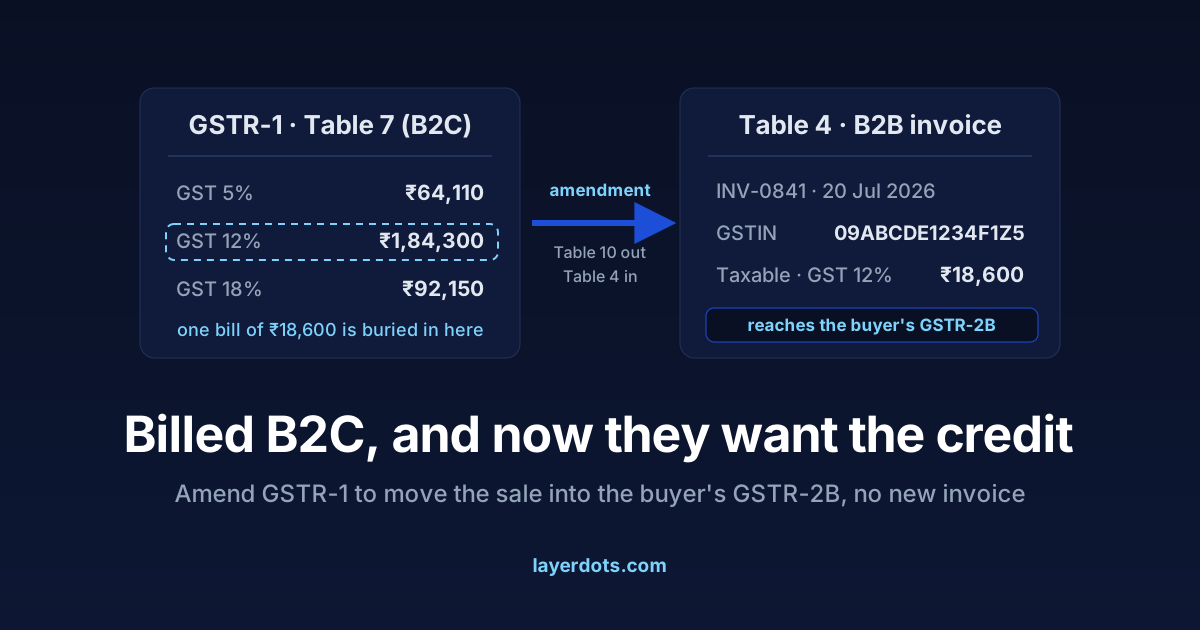
The bill went out weeks ago as an ordinary counter sale. Now the customer's accountant is on the phone: the firm is GST registered, the purchase has to appear in their GSTR-2B so they can claim input tax credit, and until it does the payment stays parked. The fix exists, costs nothing in extra tax, and happens inside your GSTR-1. It is not a fresh invoice.
Amend GSTR-1; leave the invoice as it is
Keep the invoice number and the invoice date exactly as they are. The sale happened when it happened, and the tax on it was already paid through that month's GSTR-3B. What is wrong is the reporting. In your GSTR-1 the sale went into a B2C table, anonymous, and nothing anonymous reaches a buyer's GSTR-2B, because 2B is assembled from the invoices your GSTR-1 names, buyer by buyer. So the sale has to be re-reported as a B2B invoice carrying the customer's GSTIN, through the amendment tables of a later GSTR-1.
Two things to do on your side today. First, correct your own record so the same invoice number now shows the buyer's GSTIN, and hand over a fresh print of it: Rule 46 of the CGST Rules wants a registered buyer's GSTIN on the tax invoice, and their auditor will ask for that copy. Second, note the deadline. Under the proviso to Section 37(3), a GSTR-1 entry can be amended only up to 30 November following the end of the financial year, or the filing of that year's annual return, whichever comes first. A bill from March has a real clock on it.
Which table the sale went into
How you amend depends on where the sale went in GSTR-1, and for a shop the answer is almost always the awkward one.
| Where it went | What sits there | How it is amended |
|---|---|---|
| Table 4 (B2B) | Invoice-wise rows with the buyer's GSTIN. Where this sale should have been. | Table 9A, invoice by invoice. |
| Table 5 (B2C large) | Invoice-wise rows: inter-state sales to unregistered buyers above ₹1 lakh per invoice (₹2.5 lakh until Notification No. 12/2024-Central Tax, 10 July 2024, which the GST portal applied from the August 2024 return period; older pages still quote the old limit). | Table 9A, but the invoice type is locked. See below. |
| Table 7 (B2C others) | Everything else sold to unregistered buyers, as one consolidated figure per rate. No invoice numbers at all. | Table 10, which amends the consolidated figure, plus a fresh entry in Table 4. |
A walk-in customer in your own state goes to Table 7 whatever the bill value. Table 5 needs an inter-state sale above ₹1 lakh to someone unregistered, which at a shop counter is rare. So the common case is the one with no invoice-level row to work with.
The counter-sale case: Table 10 down, Table 4 up
Your ₹18,600 bill is not in the return as a bill. It is dissolved into a single rate-wise total along with every other cash sale of the month. There is nothing to click on and convert into a B2B row, because no row for it exists. The amendment is therefore two entries in a later GSTR-1 that cancel each other.
- In Table 10, amend the original month's B2C (others) summary downward: reduce the taxable value and tax for that rate by exactly the invoice's amounts.
- In Table 4, enter the invoice as a normal B2B invoice: the customer's GSTIN, the original invoice number, the original date, the same values. The portal accepts an invoice dated in an earlier period here; it is the same door used for a missed invoice.
One entry goes down and the other goes up by the same amount, so your liability for the amendment month does not move and no interest arises. The tax itself was paid in the original month. Keep a one-page working that ties the two entries to the invoice, because a Table 10 reduction filed without its Table 4 twin, or the other way round, is precisely how GSTR-1 and GSTR-3B start disagreeing, and that mismatch now generates automatic notices.
One check before any of this if the buyer is registered in another state. For goods handed over at your counter, the place of supply is your state, so you charged CGST and SGST correctly even though their GSTIN is from elsewhere, and the amendment does not turn the sale into an IGST one. Credit of another state's CGST and SGST is generally not usable by them. Have both CAs agree on the treatment before you amend anything, or you will do the work and they still will not get a credit they can use.
The B2C-large case: the row exists, and the portal will not convert it
If the sale was inter-state and above ₹1 lakh, it went into Table 5 invoice by invoice, so you might expect to amend it straight into a B2B invoice through Table 9A. The portal does not allow that. Table 9A will let you revise the values, the invoice number or the date of a B2C large invoice, but it has no field for a GSTIN, and the GSTN helpdesk's standing answer is that an invoice cannot be amended from one type to another.
Practitioners work around this by amending the Table 5 invoice down and reporting the sale afresh in Table 4, or by issuing a credit note under Section 34 against the original and raising the sale again. Both routes work, neither is what the credit-note provisions were written for, and the paper trail has to be clean. If your case is this one, do it with your CA rather than from a blog, this one included.
Before you amend: how far has the month travelled
Check how far the original month has gone before filing anything.
- That month's GSTR-1 is not filed yet. No amendment needed. Take the sale out of the B2C summary, enter it in Table 4 with the GSTIN, file normally.
- GSTR-1 is filed but GSTR-3B is not. Since mid-2024 there is a window here: GSTR-1A lets you correct the same period's GSTR-1 after filing it and before filing that month's 3B. The correction lands in your own 3B for the same month.
- Both are filed. The amendment tables of the next GSTR-1, as above. This is the usual case; a missing credit tends to be noticed at reconciliation, well after your filing.
One door no longer exists: quietly adjusting the figures in GSTR-3B. Since the July 2025 tax period the outward liability in 3B is pre-filled from GSTR-1 and locked, so every correction now travels through GSTR-1 or GSTR-1A. It was never the right route anyway; 3B carries no invoices, so it could never feed a buyer's 2B.
When the buyer will see it
GSTR-2B is generated once a month, on the 14th, from the GSTR-1 filings of the period before. Even a perfect amendment filed today shows up only in the next run, so do not promise it will appear tomorrow. A realistic timeline for a monthly filer: the bill is dated 20 July, the accountant calls on 25 August, July's returns are long filed, so the fix goes into August's GSTR-1 filed by 11 September, and the invoice appears in the buyer's GSTR-2B generated on 14 September. They claim the credit in the 3B they file after that. From the phone call to a visible credit, three to four weeks. A GSTR-1A correction, caught before 3B, still reaches the buyer only in the following month's 2B, so 1A saves your paperwork, not their wait. If you file quarterly under QRMP the wait can stretch across the quarter; ask your CA whether the B2B entry can travel earlier through the IFF.
When the answer is no
Past 30 November following the financial year (or your annual return, if filed earlier), Section 37(3) shuts the amendment window, and there is no path that puts the invoice into the buyer's 2B. The buyer's own claim expires on the same 30 November under Section 16(4), so even heroics on your side would buy them nothing. Say it plainly: the return cannot be changed now, and what remains is a commercial conversation about the price, not a filing.
Do not let anyone talk you into cancelling the old bill and raising a fresh one dated today for the same goods. That manufactures a second taxable sale you would owe GST on, plus a gap in your records where the first one stood, plus a buyer's invoice date that no longer matches the goods they received. We have covered what cancelling an invoice does to your GST records; a payment dispute is not a reason to go there. And if your turnover is above ₹5 crore, a genuine B2B invoice needs an IRN under e-invoicing, which a bill born as B2C never had. That collision belongs on a CA's desk, not in a hurry at the counter.
Ask before the bill exists
Every path above costs a month and a working paper. Asking "regular bill, or GST bill with your firm's number?" before you press print costs four seconds, the way a pharmacy asks for a phone number. Once the GSTIN is on the invoice from the start it flows to Table 4 on its own. An invoice can be amended more than once and the consolidated B2C figures adjusted more than once, but every amendment is visible to the department, and a pattern of B2C-to-B2B conversions invites questions. The amendment is the repair; the question at the counter is the fix.
Software should carry that habit. In Layerdots ERP the GSTIN is kept on the customer record, so a repeat buyer's number attaches the moment you pick their name, and any bill that carries a GSTIN goes into the B2B section of the GSTR-1 export on its own, separate from the B2C summary. The awkward part of this article exists only for sales where nobody asked.