An export invoice carries two currencies: the dollars or dirhams your buyer will pay, and the rupee value on which GST is worked out. The buyer's side is fixed by contract. The rupee side is fixed by law, and the machinery behind it changed in July 2024, quietly enough that most pages ranking for this question still describe the old one. This is the current answer, with the rule numbers to check it against.
Rule 34(1): the customs rate, export column, from ICEGATE
Rule 34(1) of the CGST Rules settles it for goods. The rate of exchange is "the applicable rate of exchange as notified by the Board under section 14 of the Customs Act, 1962 for the date of time of supply of such goods". The Board is CBIC. Not the RBI reference rate, not your bank's remittance rate, not whatever a currency site showed that morning. The same rate list customs uses to value cargo also values your invoice.
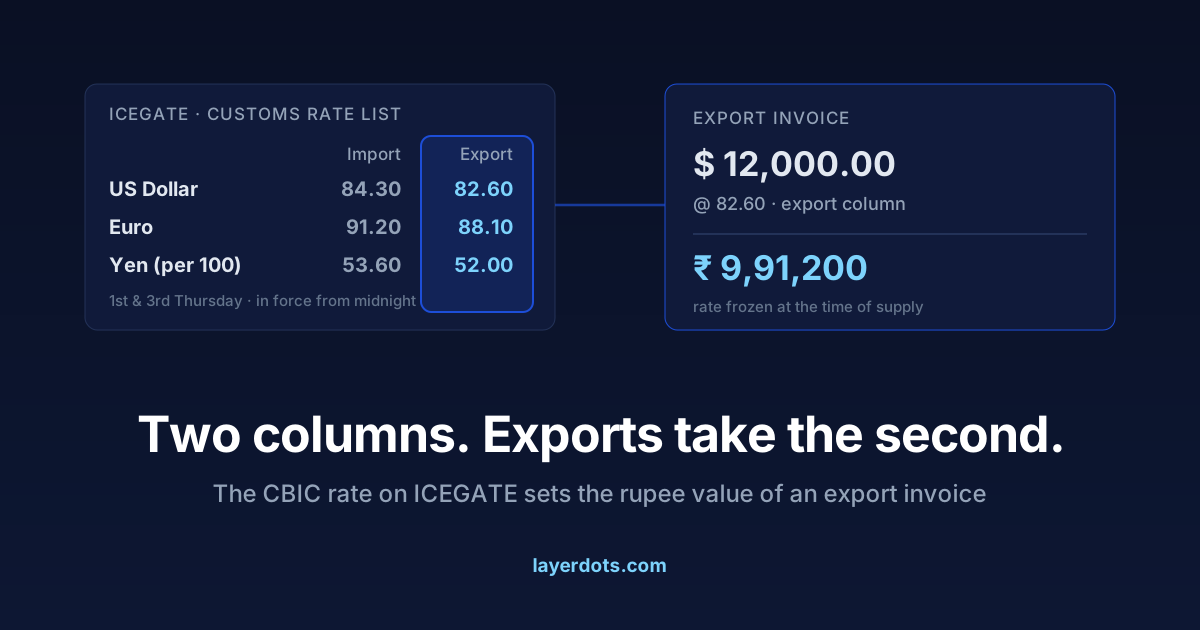
Since 4 July 2024 that list is published on the ICEGATE portal, under its View Exchange Rate service, and nowhere else. It quotes 22 currencies, each with two rates: one for imported goods, one for export goods. An export invoice takes the export goods column, at the rate in force on the date of time of supply. The rest of this article is the detail that keeps that answer right.
One boundary first. This is the rule for goods. For exported services, Rule 34(2) points somewhere else: the rate "determined as per the generally accepted accounting principles" for the date of time of supply, which in practice means the rate your accountant consistently books, commonly the RBI reference rate. Much of the advice online quotes one rule to the other's reader, which is why the RBI rate keeps being suggested for goods. This article is about goods.
The notifications ended on 4 July 2024
For years the customs exchange rate arrived as a numbered notification under Section 14, a fortnightly PDF on the CBIC site. That series is closed. Circular No. 07/2024-Customs, dated 25 June 2024, replaced it with the Exchange Rate Automation Module (ERAM) with effect from 4 July 2024. State Bank of India now feeds the rates to customs electronically and ICEGATE publishes them. No exchange-rate notification has been issued since.
The rhythm is fixed by the circular. Rates are published on the evening of the 1st and 3rd Thursday of each month, by 6 pm, and take effect from midnight of the following day, holding until the next cycle. If the Thursday is a holiday, the latest received SBI rates go up that Thursday anyway, an amendment made by Circular No. 17/2024-Customs on 18 September 2024. The circular also allows a revised rate inside the fortnight if a currency swings sharply.
So any page telling you to check the latest CBIC exchange rate notification, or linking a notification PDF as current, describes machinery that stopped in July 2024. The rates continue under the same Section 14 authority; only the address changed. Past lists stay available on ICEGATE, which matters, because old invoices need old rates. Third-party rate pages can lag the fortnightly cycle or show the import column first, so for a figure that feeds a return, take it from ICEGATE itself.
Two columns per currency; exports take the lower one
The list quotes each currency twice. The import column tracks the selling side of the rate and sits higher; the export column tracks the buying side and sits lower. This is the shape, from the last list published as a notification, in force from 21 June 2024.
| Currency | Imported goods (₹) | Export goods (₹) | Gap |
|---|---|---|---|
| US Dollar | 84.30 | 82.60 | 2.0% |
| Euro | 91.20 | 88.10 | 3.4% |
| Pound Sterling | 107.85 | 104.35 | 3.2% |
| Japanese Yen (per 100) | 53.60 | 52.00 | 3.0% |
| Korean Won (per 100) | 6.20 | 5.85 | 5.6% |
Rates from the final notified list, No. 45/2024-Customs (N.T.), in force 21 June 2024, shown for the structure, not for use. Pull the current fortnight's list from ICEGATE.
Picking the import column on an export invoice is the mistake nobody catches by eye. The arithmetic checks out, the printout looks fine, and every rupee value is a couple of percent high. Nothing surfaces until a computer matches the figures against the shipping bill, months later.
The yen and the won are quoted per 100
Twenty of the currencies are quoted per single unit. The Japanese yen and the Korean won sit in a separate schedule, quoted per 100 units, because a per-unit figure would be a fraction of a rupee. Read the export column as rupees per 100 yen, not per yen.
Miss that and the error is a factor of a hundred, and it still looks like a number. An invoice of ¥10,00,000 at an export rate of 52.00 per 100 yen is ₹5,20,000. Treat 52.00 as a per-yen rate and the same invoice becomes ₹5.2 crore, absurd on a moment's thought, but in a value field it is only digits, and software will print it and carry it into your return.
The rate in force on the invoice date, and it stays there
Rule 34(1) names a specific date: the time of supply of the goods under Section 12 of the CGST Act. For a registered exporter of goods that is, in practice, the invoice date. Notification No. 66/2017-Central Tax (15 November 2017) took advances out of the time of supply for goods, so tax attaches when the invoice is issued or should have been issued, and the exchange rate attaches with it. Use the ICEGATE export rate in force on the invoice date, that is, the fortnightly list whose window covers it.
Three consequences follow. The rate on an invoice is a historical fact, like its number. If you reprint a July invoice in March it must show July's rate and July's rupee value, not March's; software that reconverts on reprint is rewriting a filed figure, and the reprint stops matching what went into July's GSTR-1. Second, the shipping bill legitimately uses a different date. Under Section 14 of the Customs Act, customs converts the export value at the rate in force on the date the shipping bill is presented. If your invoice is dated the 2nd and the shipping bill is filed on the 9th, with a rate change between them, the two documents carry two rates and neither is wrong; they answer two different legal questions, so do not "correct" one to match the other. Third, realisation does not reopen the value. If the buyer pays three weeks later and the rupee has moved, the difference between the invoiced rupee value and what the bank credits is an exchange gain or loss in your books, an accounting entry and not a GST event. The bank's realisation paperwork carries its own rate, and that is fine.
A wrong rate stalls the IGST refund
The rupee value built from this rate is not decoration. It goes into Table 6A of GSTR-1 against the shipping bill number, date and port code. Once GSTR-1 and GSTR-3B are filed, GSTN checks the two returns against each other (the IGST in Table 6A must be covered by Table 3.1(b) of GSTR-3B, one more reason the two returns must not drift apart), then transmits the invoice data to ICEGATE to be matched against the shipping bill, field by field. A refund of IGST paid on exports moves only after that match succeeds.
A wrong exchange rate breaks that match. The value in the return disagrees with the value customs holds, and the refund does not move. No notice arrives; the money sits until someone asks why a refund from four months ago has not landed. The fix runs through amending the return (Table 9A of a later GSTR-1) and waiting for retransmission. Per invoice the error is usually two or three percent, which is why it goes unnoticed; across a year it is a consistent misstatement of export turnover.
Exporting under a Letter of Undertaking does not make the rate optional. There is no IGST on the invoice, but Table 6A still carries the rupee value, and the refund of input tax credit is computed from export turnover, so the figure does the same work. The LUT has its own failure mode, covered in what to do when invoices were raised on an expired LUT.
What the invoice itself should show
Rule 46 governs an export invoice like any other tax invoice, with the export endorsement on top (payment of IGST, or under bond or LUT without payment). On the currency question, show three things: the foreign currency amounts your buyer will pay, the exchange rate applied, and the resulting rupee values. Printing the rate costs one line and answers the question every later reader has, whether accountant, bank or officer.
This is also work the software should remember for you. Layerdots ERP keeps a table of the CBIC rates, which you fill in from ICEGATE twice a month (there is no feed to fetch them from, and a live currency API would be the wrong number in law), and it says on its face how old the newest row is, because a stale rate is invisible on an invoice. It stamps the export-column rate onto the invoice at the time of supply, so a reprint next year shows the same figure, and prints the foreign-currency total beside the rupee total. Whatever you bill with, check those three properties: the right column, the right date, and a rate that never changes afterwards.
One adjacent obligation: exports are B2B for e-invoicing purposes, so if your turnover has crossed the e-invoice threshold, your export invoices need IRNs like any other B2B invoice.