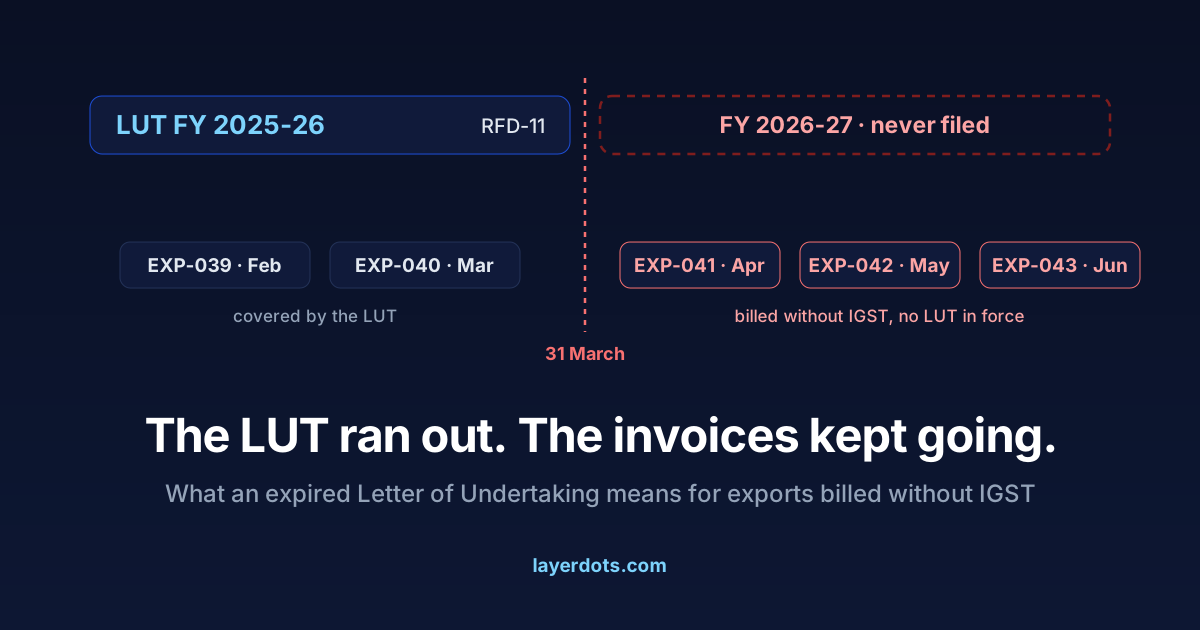
Nobody notices on 1 April. The discovery comes months later, when the CA asks for the LUT number while preparing a refund claim and the portal shows the Letter of Undertaking ran out on 31 March. Every export invoice raised since then carries the declaration "supply meant for export under Letter of Undertaking without payment of integrated tax", and there was no Letter of Undertaking. Here is what the gap can cost, and the route the department itself provides for closing it.
File the fresh LUT today, before reading further
Log in to the GST portal, go to Services, then User Services, then Furnish Letter of Undertaking, pick the financial year, and submit form GST RFD-11. Under Circular No. 40/14/2018-GST dated 6 April 2018, the LUT is deemed accepted the moment the acknowledgement with an Application Reference Number (ARN) generates. No officer approves it, nothing is submitted on paper, and the whole exercise takes about fifteen minutes.
Filing today does one thing only: it stops the gap growing. Every invoice raised after the ARN exists is covered. It does not cure the invoices already raised, because Rule 96A wants the LUT furnished prior to export. Those need the separate treatment below, and for most exporters it ends at the CA's desk rather than in an article.
A financial-year document with no renewal notice
Circular No. 8/8/2017-GST dated 4 October 2017 says it in one line: the LUT is valid for the whole financial year in which it is tendered. There is no renewal notice, no banner, no email. On 31 March it stops, and on 1 April an exporter who has not filed a fresh one is billing without cover.
Almost every registered exporter qualifies for the LUT route. Notification No. 37/2017-Central Tax dated 4 October 2017 extends it to all registered persons except anyone prosecuted under GST or the earlier laws for tax evasion above ₹2.5 crore, who must furnish a bond with a bank guarantee instead. If that does not describe you, the LUT is yours for the asking, every year, free.
What the lapse breaks in law
Exports are zero-rated supplies under section 16 of the IGST Act. Since 1 October 2023, when the Finance Act 2021 amendments took effect through Notification No. 27/2023-Central Tax, the default route sits in section 16(3): a registered person making zero-rated supply may supply under bond or Letter of Undertaking without payment of integrated tax and claim refund of unutilised input tax credit. The alternative, exporting with IGST paid and claiming that tax back, now lives in section 16(4), for the goods and services notified under Notification No. 01/2023-Integrated Tax.
A caution about what ranks for this question. Many pages still cite section 16(3)(a) and 16(3)(b), the structure the section had before October 2023. If you are drafting a letter to a tax officer, cite the section as it stands now.
Rule 96A of the CGST Rules is where the LUT itself lives: the exporter furnishes it in form RFD-11 before exporting, binding himself to pay the tax due with interest if the export conditions fail. The position on your gap invoices is then uncomfortable but clear. On the day each was raised, no LUT was in force, so the supply was not made under the route section 16(3) and Rule 96A permit. The declaration printed on the invoice was not true on the date it was printed.
The exposure: the IGST, plus 18 per cent interest
The undertaking in Rule 96A is a promise to pay the tax due along with interest under section 50(1), which Notification No. 13/2017-Central Tax fixes at 18 per cent per annum. So the theoretical exposure on each gap invoice is the IGST that zero-rating would have spared, plus interest from the date it fell due. If a demanded amount goes unpaid, Rule 96A(3) withdraws the facility itself, with recovery under section 79; payment restores it under Rule 96A(4).
That is the stick. The counterweight comes from the department itself. Paragraph 44 of Circular No. 125/44/2019-GST dated 18 November 2019, the master circular on refunds, says the substantive benefits of zero rating may not be denied where it is established that the exports were in fact made, and that the delay in furnishing the LUT may be condoned, with export under LUT allowed on an ex post facto basis on the facts of each case. Courts have taken the same line, treating Rule 96A as procedural machinery rather than a trap. In practice, an exporter who can show the goods left India and the money came in usually ends up paying nothing. But condonation is a discretion exercised on your evidence, not an automatic protection.
The Rule 96A clocks kept running through the gap
Separately from the lapsed LUT, Rule 96A puts time limits on every export made without payment of tax, and these ran throughout the gap:
| What must happen | Time allowed | Where it is written |
|---|---|---|
| Goods must leave India | Three months from the date of the export invoice, or the further period the Commissioner allows | Rule 96A(1)(a) |
| Payment for exported services must arrive in convertible foreign exchange (or in rupees where the RBI permits) | One year from the date of the export invoice, or the further period allowed | Rule 96A(1)(b) |
| If either clock lapses: pay the IGST with 18 per cent interest | Within fifteen days of the lapse | Rule 96A(1) with section 50(1) |
| Goods exporters who took refunds must realise sale proceeds within the FEMA time limit, or deposit the refund back with interest | Thirty days after the FEMA window closes | Proviso to section 16(3), IGST Act, from 1 October 2023 |
Note the reference point. The three months run from the date of issue of the invoice for export, not from the shipping bill, though many articles say otherwise. For late exports, paragraph 45 of the same circular says that as long as the goods were in fact exported, even beyond three months, paying IGST first and refunding it later should not be insisted upon; the jurisdictional Commissioner may grant the extension after the fact.
What the condonation letter should contain
There is no form for this. It is a letter to the jurisdictional officer, and it should hand them everything needed to say yes:
- The fact in one sentence: the LUT for FY 2025-26 expired on 31 March 2026, and the fresh one for FY 2026-27 was furnished on such-and-such date, with its ARN.
- The old LUT's ARN and validity, so the lapse reads as a gap in an otherwise regular record.
- A table of the gap invoices: number, date, value, and against each the shipping bill number and date for goods, or the FIRC or bank realisation reference for services.
- Copies of the shipping bills and remittance proofs.
- The request itself: that the delay in furnishing the LUT be condoned and export under LUT be allowed on an ex post facto basis in terms of paragraph 44 of Circular No. 125/44/2019-GST.
This is the point to stop doing it yourself and involve your CA, ideally one who knows your range office. The circular gives the officer a power, not an obligation. If refund claims for the gap period are pending or planned, the order in which the letter and the claims go in matters, and that judgement is theirs to make.
The first week, in order
- File the fresh LUT and save the ARN and validity dates where both your billing software and your CA can see them.
- List every export invoice from 1 April onwards: number, date, value, and the shipping bill or remittance status against each.
- Test that list against the Rule 96A clocks above. Goods invoices past three months with no shipping bill, or service invoices nearing a year with no remittance, carry a live liability whatever happens to the condonation. Flag them first.
- Take the file to your CA and choose between the condonation letter and, in a bad case, paying the tax and interest to close the matter.
- Keep GSTR-1 truthful. Exports sit in Table 6A marked "without payment of tax"; report the gap invoices as issued and let the condonation regularise them, because re-describing past months opens the sort of gap covered in GSTR-1 versus GSTR-3B mismatches.
- While you are at it, confirm the rest of your export paperwork is current. If your turnover is above the e-invoicing threshold, export invoices need e-invoices too.
15 March, every year
The prevention is small next to the cure. The portal accepts the coming year's LUT before the year begins, and most CAs file their exporters' LUTs in the last week of March. Put a recurring reminder on 15 March, file for the year starting 1 April, save the new ARN, and this whole class of problem disappears for twelve months. The portal itself will not warn, remind or block.
Software can hold the second line. Layerdots ERP stores the LUT's ARN and validity dates on the shop profile, refuses to raise a without-payment export invoice when no LUT on file covers the invoice date, and its check before filing GSTR-1 names any invoice dated after the LUT it was raised under had expired. The person billing at the counter should not be the one who has to remember a March deadline.
Exports carry other clockwork besides the LUT. The exchange rate that must appear on the invoice, and where that number now comes from, is its own subject: the exchange rate on export invoices.
Questions exporters ask at this point
We filed the new LUT in August. Does it cover the invoices from April to July?
Not by itself. An LUT is valid for the financial year in which it is tendered, but Rule 96A
wants it furnished before export, and these invoices were raised when nothing was in force.
The instrument for those months is condonation under paragraph 44 of Circular 125/44/2019.
File the LUT for the future; request condonation for the past.
Every consignment was shipped and paid for. Do we still owe the IGST?
On the department's own circular, no, provided condonation is sought and allowed: the
substantive benefit of zero rating is not to be denied where export is established. Keep the
shipping bills and remittance certificates together; that evidence is the whole case. Do not
do nothing on the theory that the circular protects you automatically. A discretion nobody
has exercised protects nobody.
Can we switch the gap invoices to "with payment of IGST" and claim the refund
instead?
It is rarely clean. The shipping bill already says the export was under LUT without payment,
and the Rule 96 refund route works off what the shipping bill and GSTR-1 said at the time;
rewriting the story afterwards tends to strand the refund in matching. Condonation is usually
the shorter path; let your CA drive any exception.
Is there a late fee or penalty for the LUT itself?
There is no fee or prescribed late fee for the LUT itself. The exposure lives on the invoices
raised during the gap: the IGST the lapsed cover would have spared, plus 18 per cent interest
under section 50(1). Condoned cases normally end without penalty; get the condonation on
record rather than leaning on that word.
We export services, not goods. Anything different?
The mechanics and the fix are identical. The clock differs: for services the condition is
receiving payment in convertible foreign exchange, or in rupees where the RBI permits it,
within one year of the invoice date. Your evidence is FIRCs and bank realisation certificates
instead of shipping bills. Watch the one-year mark on each gap invoice while the condonation
is in progress.