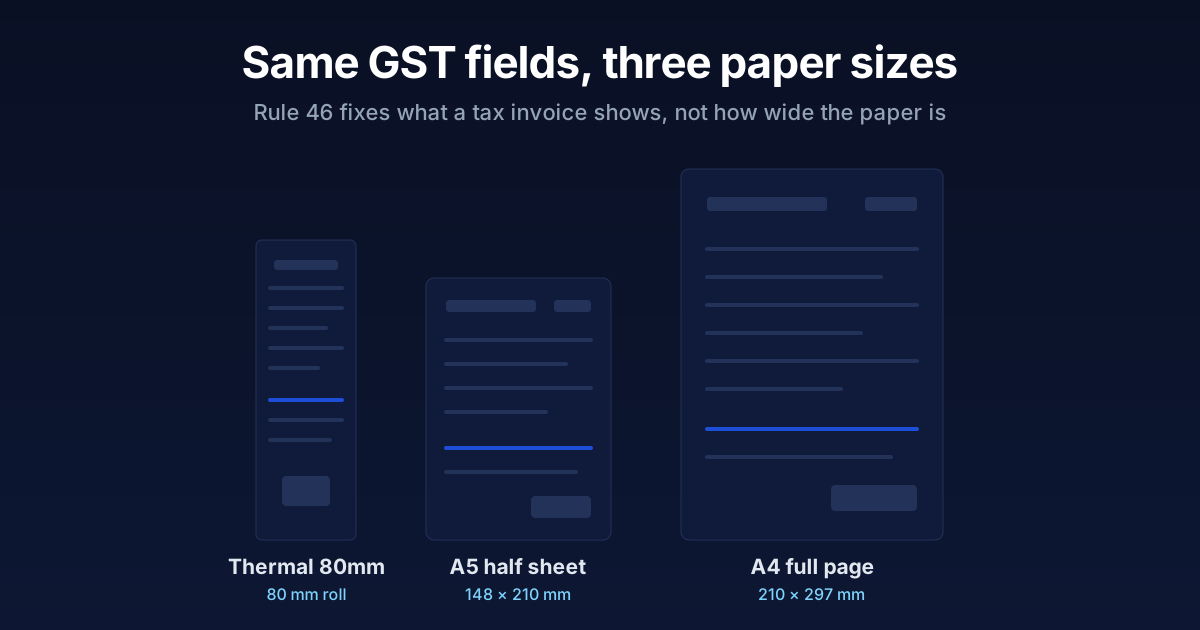
A printer for the counter looks like a simple purchase until you are standing in the market with the choices in front of you: a thermal receipt printer, an A5 bill like the one the pharmacy next door hands out, or a plain A4 printer. Underneath sit real questions. Is a thermal receipt even valid for GST? What will paper and ink cost over a year? And which format suits the kind of selling you do? One at a time.
Rule 46 lists fields, not paper sizes
Start with the worry that stops most people: legality. GST law does not prescribe a paper size for a tax invoice. Section 31 of the CGST Act says a registered person must issue a tax invoice, and Rule 46 of the CGST Rules lists what that invoice must show: your name, address and GSTIN, a consecutive serial number of up to sixteen characters, the date, the description, quantity and value of the goods, the HSN code, the rate and amount of tax, the place of supply on an inter-state sale, and so on. Read Rule 46 end to end and you will not find a line about millimetres.
So a 58 mm receipt carrying all the required fields is a valid tax invoice, and an A4 page missing your GSTIN is not. The paper decides how readable and how durable the bill is, never whether it is legal.
80 mm and 58 mm rolls
A thermal printer prints by heating chemically coated paper. No ink, no toner, no cartridge to run dry in the middle of the evening rush. It is the fastest of the three by a distance: a receipt comes out in a second or two, cut and ready, which is why supermarkets use nothing else at the till.
The two common widths are 80 mm and 58 mm, and the extra 22 mm matters more than it sounds, because a GST receipt has to fit item names plus a tax split. On 80 mm you can print a readable item name, quantity, rate and the CGST and SGST amounts on one line. On 58 mm something has to shrink, usually the item name, so 58 mm suits the simplest receipts: a few items, short names, a total. If your items carry long names, medicine brands or hardware sizes and grades, 80 mm is the safer buy.
A receipt printer does not print the stickers on your shelves. That is a separate machine, covered in barcode labels for a small shop.
Thermal print fades, so the record has to be digital
Thermal paper fades. Heat, sunlight, friction and even the adhesive in some laminating pouches attack the print. A receipt left near a window or in a wallet can turn grey in weeks and blank in months. For the customer's copy this is usually acceptable; nobody frames a grocery receipt. For your own records it is not.
Section 36 of the CGST Act requires you to keep your accounts and records for seventy-two months from the due date of the annual return for that year. That is six years, far beyond the life of thermal print. The paper cannot be your record. The record has to be the bill stored in your billing software, searchable by number, date or customer, with a backup that lives somewhere other than the shop PC. Treat the thermal receipt as the customer's copy and the digital bill as yours.
A5, the half sheet
A5 is half an A4 sheet, 148 × 210 mm. It hits a middle point many counters have settled on: wide enough for proper columns, small enough to hand over folded once, and it reads as a proper bill rather than a till receipt. That last part matters when the customer needs the bill for an insurance claim, a reimbursement or a warranty. Pharmacies in particular favour it because a medicine bill wants batch number and expiry columns and often a doctor's name, which billing for a medical store goes into. You do not need special hardware: most inkjet and laser printers accept A5 from the tray, or A4 sheets cut in half.
A4 for anything headed for a file
A4 earns its place the moment a bill is headed for a file. An invoice to a buyer with a GSTIN carries more content: the buyer's GSTIN and address, full HSN and tax columns, sometimes payment terms and bank details, and their accountant will punch and file the page. Itemised job work, quotations converted to bills, credit bills that a customer's office reimburses at month end: same logic. If nearly all your sales are walk-in, printing A4 for each one is slow and wasteful. But if a meaningful slice of your business is B2B, you will need A4 for those bills whatever the counter uses.
What each printer costs to buy and to run
Prices shift constantly, so treat these as shapes rather than quotes and check current prices before you buy. The shapes are stable.
- Thermal: the printer is typically a few thousand rupees. After that the only consumable is the paper roll, and one inexpensive roll yields a few hundred receipts. Nothing dries up if the shop stays closed for a week.
- Inkjet (cartridge): cheapest to buy, costliest to feed. Cartridge cost per page adds up quickly at billing volumes, and an idle inkjet clogs.
- Ink tank: costs more upfront than a cartridge inkjet, but the ink cost per page drops to paise. For steady A5 or A4 billing this is usually the sensible middle.
- Laser: fast, sharp text, and a toner cartridge lasts thousands of pages. Higher upfront cost; the per-page cost lands near ink tank territory.
The arithmetic is bills per day, times pages per bill, times cost per page, run over a year. Do it once with your own numbers. At a few dozen A4 bills a day, a year of paper and ink can cost more than the billing software driving the printer; the other half of that sum is in what billing software costs in India.
One shop, two printers
Plenty of shops end up with two printers, and it is not extravagance. The thermal sits at the counter and handles walk-in sales at speed. The ink tank or laser sits in the back and handles B2B invoices, credit customers' statements and anything headed for a file. The billing software has to cooperate: paper size should be a setting, not a struggle. In Layerdots ERP the print format is a setting, A5, A4, thermal 80 mm or 58 mm, or a custom width you measure with a ruler and set with a slider, with a default picked by your kind of business, and any bill can be reprinted from history. That is the whole product mention in this article; everything else above holds whatever software you run.
Common questions
Is a thermal receipt legally valid as a GST tax invoice?
Yes, if it carries the particulars Rule 46 of the CGST Rules requires: your GSTIN, a serial
number, the date, item details with HSN, the taxable value and the tax amounts, among others.
No GST rule prescribes a paper size. Validity comes from the fields, not the width.
Do I have to print a bill for every small sale?
Not always. Under Section 31(3)(b) of the CGST Act, a registered seller need not issue a tax
invoice for a sale below ₹200 to an unregistered buyer who does not ask for one, and instead
issues one consolidated invoice for such sales at the end of the day. The sale must still be
recorded in your books; only the slip of paper is optional.
My old thermal receipts have faded to blank. Am I in trouble?
The customer's faded copy is not your record. Your obligation under Section 36 of the CGST Act
is to keep your accounts and records for seventy-two months from the annual return's due date,
and a digital bill history with backups satisfies the keeping part in practice. If a bill is
ever questioned, you reprint it from the stored data. Trouble only arrives when the fading
roll was the sole place the sale existed.